
-
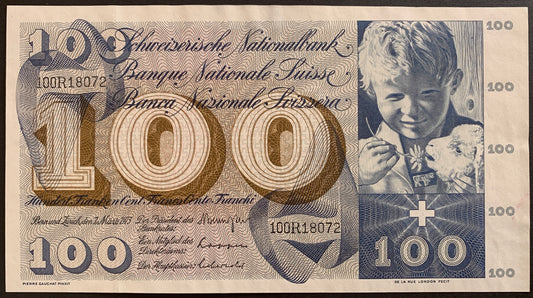
Switzerland 100 Francs 1973 P-49o UNC
Regular price 56.290 HUFRegular priceUnit price per

About Switzerland banknotes
The Swiss National Bank has issued notes since 1907. The fifth series, issued from 1956, shows a boy's portrait on the 100 francs and Saint Martin sharing his cloak with a beggar on the back. Switzerland replaces its series every few decades; notes from the sixth series of 1976 onwards can be exchanged at the Swiss National Bank without time limit, while the fifth series is no longer exchangeable.
See also: European banknotes, Germany, Austria and banknotes with weapons.
Frequently asked questions
What is on the Swiss 100 francs of 1973?
A boy's head on the front and Saint Martin sharing his cloak with a beggar on the back.
Can old Swiss notes be exchanged?
Notes from the sixth series (1976) onwards can be exchanged at the Swiss National Bank for an unlimited time. Older series, like this 1973 note, can no longer be exchanged and are valued by collectors.
Who issues Swiss banknotes?
The Swiss National Bank, which has issued notes since 1907.
Are your Switzerland banknotes genuine?
Yes. Every Switzerland note we sell is a genuine banknote, never a copy or replica. Each listing states the grade, gives the Pick catalogue number where one exists and shows the front and back, and every order ships tracked from Hungary.
Collector guides
Before you buy
- How to Buy Banknotes Safely Our checklist: trustworthy sellers, grades, Pick numbers, replicas and fair prices. Read the guide →
- Banknote Grading Explained What UNC, AU, XF, VF and F mean, with real examples, and how to check a note yourself. Read the guide →
- Pengő vs Milpengő vs B.-Pengő Every 1946 Hungarian note in one table, up to the 100 quintillion pengő record. Read the guide →
- Hyperinflation Banknotes, Ranked The worst inflations in history, from Hungary 1946 to Zimbabwe 2008, and their record notes. Read the guide →