
-
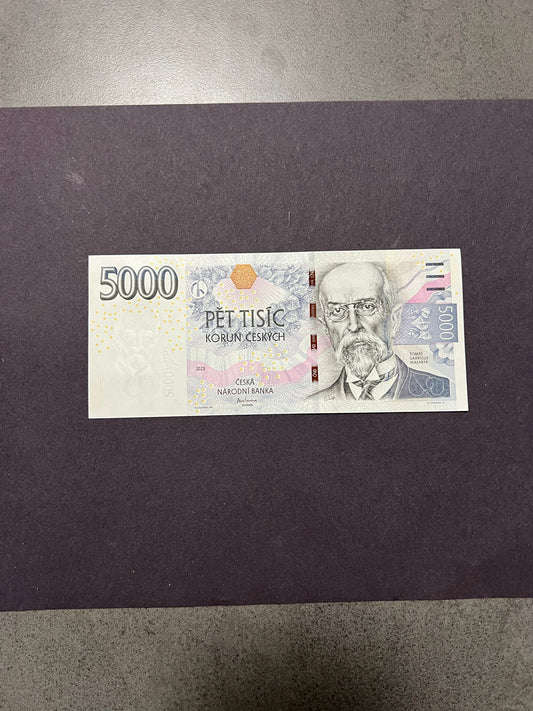
Czech Republic 5000 Korun 2023 P-27 Type UNC – T. G. Masaryk
Regular price 85.390 HUFRegular priceUnit price per

About Czech Republic banknotes
When Czechoslovakia split peacefully into the Czech Republic and Slovakia on 1 January 1993, both countries created their own currencies. The Czech Republic first stamped Czechoslovak notes and then issued its own Czech koruna series, honouring figures from Czech history such as Charles IV, Emmy Destinn and Tomáš Garrigue Masaryk.
The Czech Republic joined the European Union in 2004 but still uses the koruna rather than the euro.
See also: Czechoslovakia, Slovakia and European banknotes.
Frequently asked questions
When did the Czech Republic get its own banknotes?
The Czech Republic introduced the Czech koruna on 8 February 1993, a few weeks after Czechoslovakia split on 1 January 1993.
Who is on the 5000 korun note?
Tomáš Garrigue Masaryk (1850–1937), the founder and first president of Czechoslovakia.
Does the Czech Republic use the euro?
No. The Czech Republic is an EU member but has kept its own currency, the Czech koruna.
Are your Czech Republic banknotes genuine?
Yes. Every note we sell is a genuine banknote, never a copy or reproduction, and is described honestly by grade.
Collector guides
Before you buy
- How to Buy Banknotes Safely Our checklist: trustworthy sellers, grades, Pick numbers, replicas and fair prices. Read the guide →
- Banknote Grading Explained What UNC, AU, XF, VF and F mean, with real examples, and how to check a note yourself. Read the guide →
- Pengő vs Milpengő vs B.-Pengő Every 1946 Hungarian note in one table, up to the 100 quintillion pengő record. Read the guide →
- Hyperinflation Banknotes, Ranked The worst inflations in history, from Hungary 1946 to Zimbabwe 2008, and their record notes. Read the guide →