
-
Italy 10000 Lire 1984 P-112d AUNC
Regular price 2.690 HUFRegular priceUnit price per -
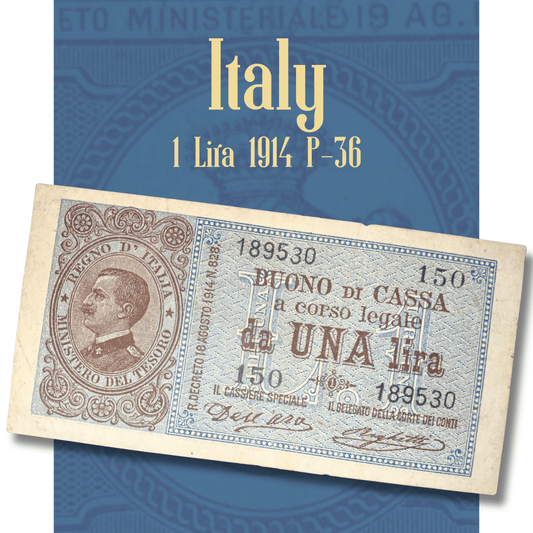
Italy 1 Lira 1914 P-36 VF
Regular price 4.290 HUFRegular priceUnit price per -
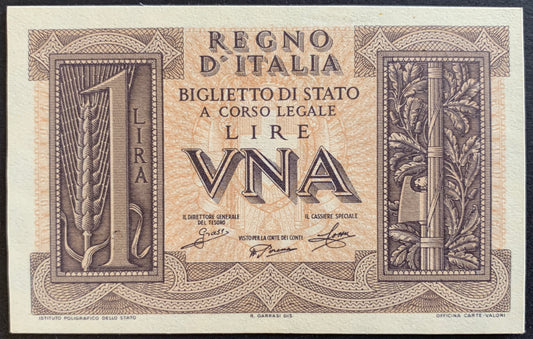
Italy 1 Lira 1939 P-26 UNC
Regular price 6.990 HUFRegular priceUnit price per -
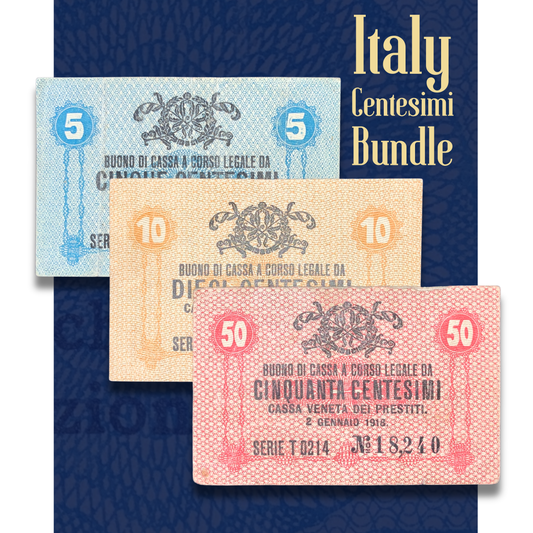
Italy 1918 Centesimi VF – Cassa Veneta dei Prestiti Bundle
Regular price 16.390 HUFRegular priceUnit price per -
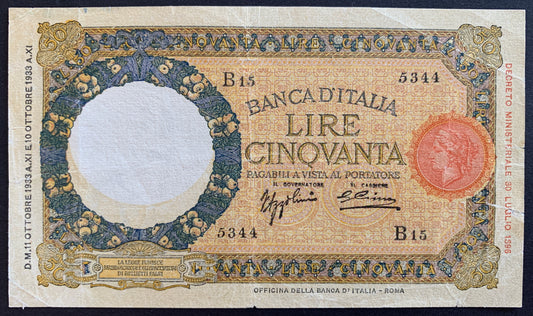
Italy 50 Lire 1933 P-54a F (Lupetta)
Regular price 17.590 HUFRegular priceUnit price per





About Italy banknotes
Italy used the lira from unification in 1861 until the euro in 2002, at 1,936.27 lire per euro. Notes were issued by the State and by the Banca d'Italia; the 1933 50 lire is nicknamed "Lupetta" for the she-wolf of Rome on its back. Inflation after the Second World War made notes of 10,000 lire and more common.
See also: European banknotes, World War I banknotes and Austria.
Frequently asked questions
Why is the 1933 50 lire called "Lupetta"?
"Little she-wolf": it shows the she-wolf suckling Romulus and Remus, the legendary founders of Rome.
When did Italy adopt the euro?
On 1 January 2002, at 1,936.27 lire per euro.
Who issued Italian lira notes?
The Banca d'Italia and, for smaller values, the Italian State.
Are your Italy banknotes genuine?
Yes. Every Italy note we sell is a genuine banknote, never a copy or replica. Each listing states the grade, gives the Pick catalogue number where one exists and shows the front and back, and every order ships tracked from Hungary.