
-
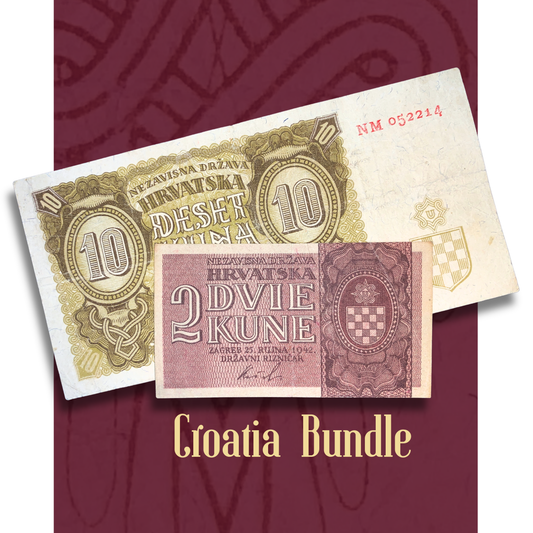
Croatia 1941–1942 Kuna Bundle
Regular price 5.990 HUFRegular priceUnit price per

About Croatia banknotes
The kuna, named after the marten whose pelts were once used in trade, was first introduced in 1941 by the Independent State of Croatia, a wartime state allied with Nazi Germany. It disappeared in 1945. Croatia brought the kuna back in 1994 after independence, and replaced it with the euro on 1 January 2023.
See also: European banknotes, World War II banknotes, Yugoslavia and Serbia.
Frequently asked questions
What does "kuna" mean?
It is the Croatian word for the marten, a small animal whose fur was used as money in the Middle Ages.
Does Croatia still use the kuna?
No. Croatia adopted the euro on 1 January 2023.
When was the modern kuna introduced?
In 1994, after Croatian independence.
Are your Croatia banknotes genuine?
Yes. Every Croatia note we sell is a genuine banknote, never a copy or replica. Each listing states the grade, gives the Pick catalogue number where one exists and shows the front and back, and every order ships tracked from Hungary.