
-
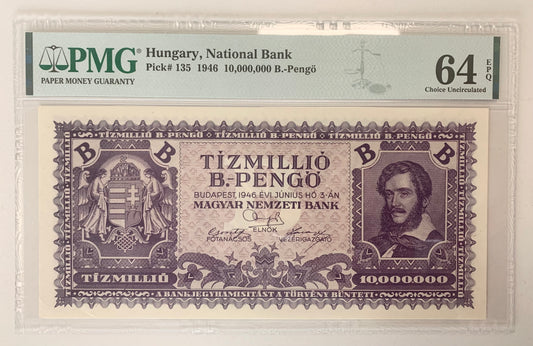
Hungary 10 Millió B-Pengő 1946 UNC PMG 64 EPQ P-135
Regular price 60.190 HUFRegular priceUnit price per -
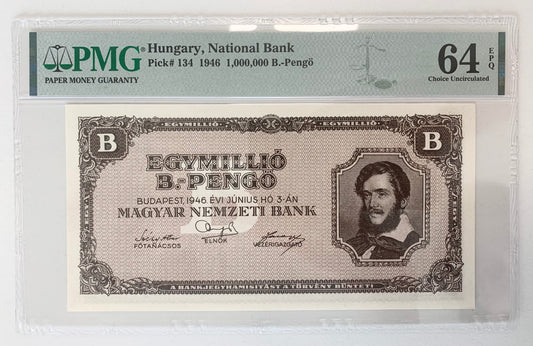
Hungary 1 Millió B-Pengő 1946 UNC PMG 64 EPQ P-134
Regular price 65.890 HUFRegular priceUnit price per82.390 HUFSale price 65.890 HUF⚡ Extreme Index 9.1Sale -
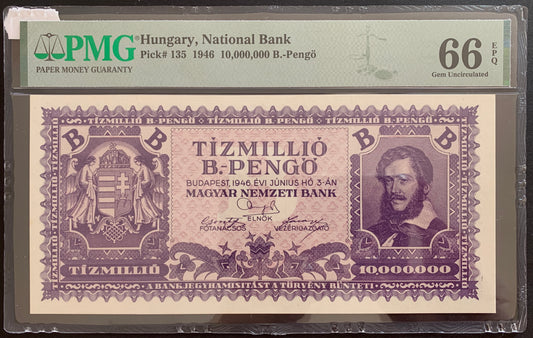
Hungary 10 million B.-Pengő 1946 P-135 PMG 66 EPQ GEM UNC
Regular price 76.690 HUFRegular priceUnit price per -
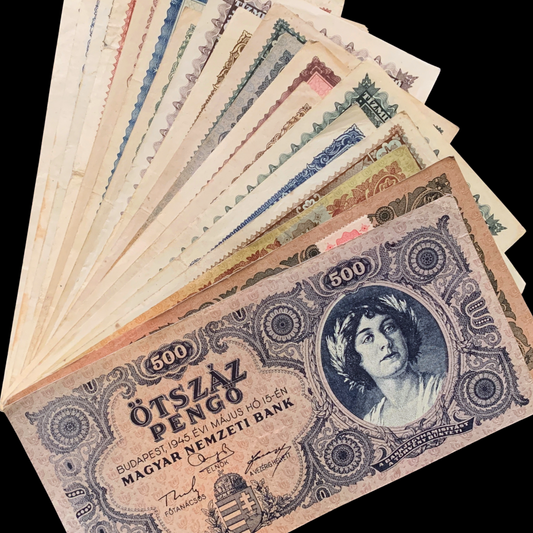
Hungary WWII 1946 F-XF – Complete Hyperinflation Bundle
Regular price 109.090 HUFRegular priceUnit price per -
Hungary B.-Pengő 1946 F-XF – Complete Hyperinflation Bundle
Regular price 124.090 HUFRegular priceUnit price per





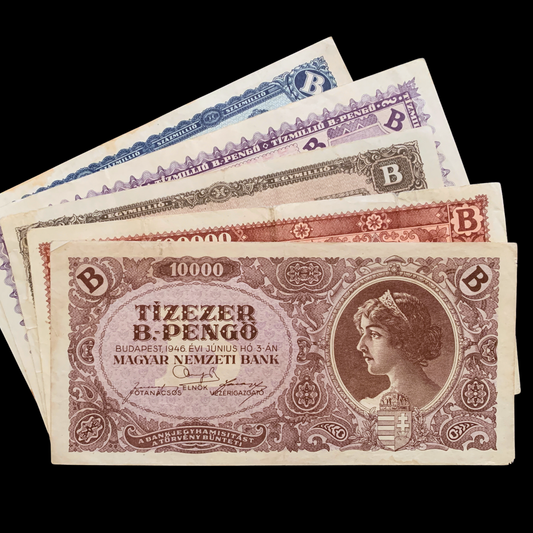
About hyperinflation banknotes
War and economic collapse
The Second World War left Hungary's economy in ruins, and the National Bank was soon printing pengő notes up to 1 milliárd (1,000,000,000). As prices kept rising it introduced the milpengő, one million pengő, and then the B.-pengő ("billió pengő"), one million million pengő. The 100 million B.-pengő, worth 100,000,000,000,000,000,000 pengő, is the highest denomination ever to circulate anywhere. In July 1946 prices doubled about every 15 hours, until the forint replaced the pengő on 1 August 1946 at 400,000 quadrillion pengő to one forint.
Other great hyperinflations
Germany printed notes of up to 100 trillion marks in 1923; Greece reached 100 billion drachmai in 1944; Yugoslavia issued a 500 billion dinara note in 1993; and Zimbabwe printed a 100 trillion dollar note in 2009. Each left behind notes that are now prized for the story they tell.
A collector's dream, a cautionary tale
These banknotes are more than just high numbers. They capture the moment when money lost all meaning. Yet even in the chaos, Hungarian notes were issued in carefully designed series, with colour variations, changing security features and evolving paper quality, a rich field for study and comparison.
See also: pengő, Hungary, Zimbabwe, Yugoslavia and Germany.
Collector's guide: Pengő vs milpengő vs B.-pengő – every 1946 Hungarian hyperinflation note explained.
Frequently asked questions
What is hyperinflation?
Extremely fast inflation, usually defined as prices rising by more than 50% in a single month. At its worst, money loses value by the hour.
Which country had the worst hyperinflation ever?
Hungary in 1945–1946. In July 1946 prices doubled roughly every 15 hours, the highest inflation rate ever recorded.
What is the highest denomination banknote ever issued?
The Hungarian 100 million B.-pengő of 1946, worth 1020 pengő.